
- CALL : (+91) 95443 09166
- Support : (+91) 95443 09166
- IP Health
- Jul 08
- 5 mins read
How Fraudsters Use VPNs, Proxies, and Tor to Bypass Security
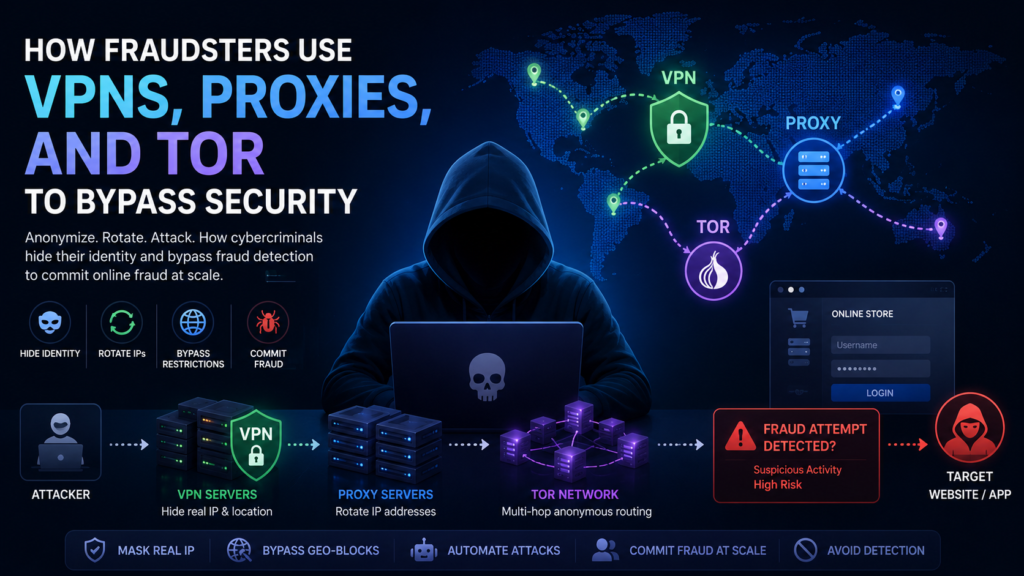
Cybercriminals have become significantly more sophisticated over the last decade. Traditional fraud prevention methods that once relied on IP blocking and simple rate limits are no longer enough. Today’s attackers use advanced anonymity tools like VPNs, proxies, and the Tor network to hide their identity, rotate IP addresses, automate attacks, and bypass security systems at scale. These technologies were originally designed for privacy and security. Millions of legitimate users rely on them every day for remote work, online privacy, secure communication, and bypassing censorship.
However, fraudsters have also adopted these tools because they make it much harder for businesses to identify suspicious traffic. For companies operating in ecommerce, fintech, SaaS, gaming, ticketing, crypto, and online marketplaces, understanding how attackers use anonymization networks is critical for preventing fraud.
In this guide, we’ll explain:
- What VPNs, proxies, and Tor are
- How fraudsters use them
- The risks they create for businesses
- The differences between them
- How to detect anonymized traffic using IP intelligence and fraud detection systems
Why VPN and Proxy Fraud Is Growing
Fraud prevention systems heavily depend on user identity signals. One of the most important signals is the IP address. An IP address helps businesses determine:
- User location
- ISP or hosting provider
- Connection type
- Network reputation
- Suspicious behavior patterns
But anonymization technologies hide these details. This makes it difficult to:
- Detect fake users
- Identify bot traffic
- Prevent account takeovers
- Stop automated abuse
- Detect payment fraud
As fraud detection systems improve, attackers increasingly rely on:
- VPN services
- Residential proxy networks
- Rotating proxy pools
- The Tor anonymity network
to avoid detection.
What Is a VPN?
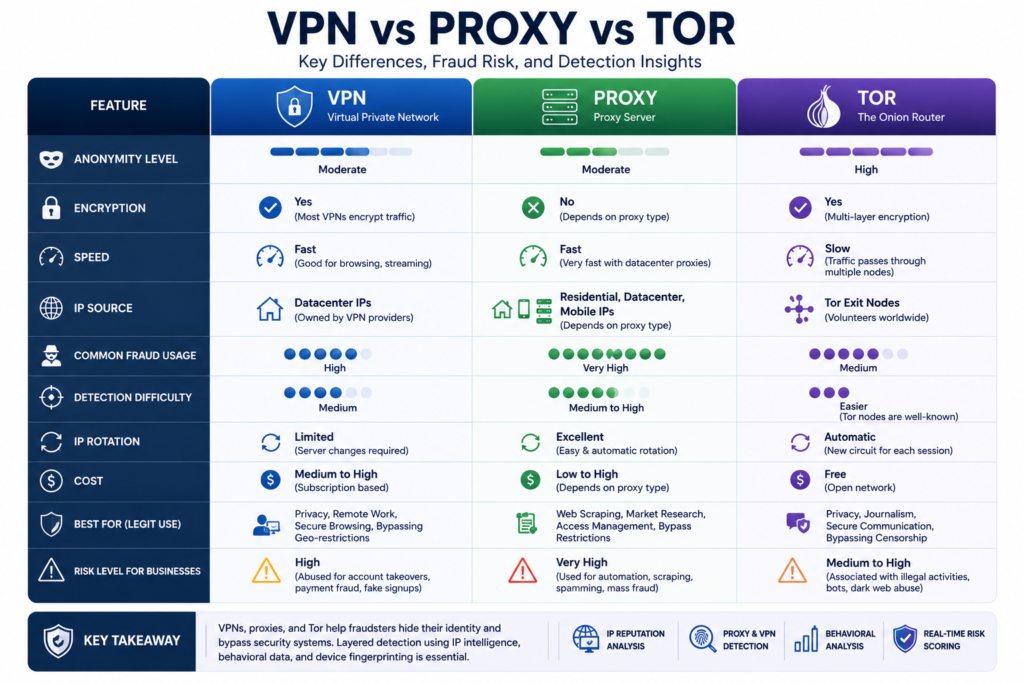
A VPN (Virtual Private Network) creates an encrypted tunnel between the user and the internet. Instead of connecting directly to a website, the user connects through a VPN server. This masks:
- The user’s real IP address
- Physical location
- ISP information
The website only sees the VPN server’s IP address. VPNs are commonly used for legitimate purposes such as:
- Online privacy
- Secure browsing
- Remote work
- Public Wi-Fi protection
- Accessing geo-restricted content
However, VPNs are also heavily abused in fraud operations.
What Is a Proxy Server?
A proxy server acts as an intermediary between a user and a website. Traffic passes through the proxy server before reaching the destination. Unlike VPNs, proxies may not encrypt traffic, but they still hide the original IP address. Common proxy types include:
- Residential proxies
- Datacenter proxies
- Mobile proxies
- SOCKS proxies
- HTTP proxies
Fraudsters use proxies to:
- Rotate IP addresses
- Avoid bans
- Automate attacks
- Create fake accounts
- Scrape websites
- Bypass rate limits
What Is the Tor Network?
Tor (The Onion Router) is a decentralized anonymity network that routes traffic through multiple encrypted relays. Instead of using a single proxy or VPN server, Tor sends traffic through several volunteer-operated nodes across the world. This makes it extremely difficult to trace the user’s identity or location. Tor is commonly used for:
- Privacy protection
- Journalism
- Secure communication
- Bypassing censorship
However, cybercriminals also use Tor because it provides strong anonymity. Tor traffic is frequently associated with:
- Fraud
- Credential stuffing
- Dark web marketplaces
- Spam
- Account abuse
- Cyberattacks
Why Fraudsters Use VPNs, Proxies, and Tor
Attackers use anonymity tools for one primary reason:
To avoid detection.
But there are several specific advantages.
1. Hiding Their Real Identity
Anonymization services conceal:
- IP address
- Geographic location
- ISP information
- Device origin
This prevents businesses from accurately identifying the attacker. A fraudster in one country may appear as a legitimate user from another region.
2. Bypassing IP-Based Blocking
Most platforms block suspicious IP addresses. VPNs and proxies allow attackers to:
- Switch IPs instantly
- Rotate between thousands of addresses
- Continue attacks after bans
This makes traditional IP blocking less effective.
3. Automating Fraud at Scale
Bots and automated scripts heavily rely on proxy infrastructure. Attackers use rotating proxies to perform:
- Credential stuffing
- Fake account creation
- Inventory abuse
- Web scraping
- Ad fraud
- Spam campaigns
Without IP rotation, these attacks would fail quickly.
4. Circumventing Geo Restrictions
Many fraud prevention systems apply region-based restrictions. Attackers use VPNs and residential proxies to:
- Simulate local traffic
- Bypass country restrictions
- Target regional promotions
- Exploit localized pricing
This is extremely common in ecommerce and ticketing fraud.
5. Evading Reputation-Based Detection
Fraud systems often flag:
- Hosting provider IPs
- Known bot networks
- Suspicious geographic patterns
Residential proxies and premium VPNs help attackers blend in with normal consumer traffic.
Why Residential Proxies Are Especially Dangerous
Residential proxies are among the hardest anonymity tools to detect. That’s because they use IP addresses assigned to real consumers by ISPs. Traffic from residential proxies:
- Looks legitimate
- Blends with normal users
- Avoids many blacklists
Fraudsters increasingly prefer residential proxy networks because:
- Detection rates are lower
- Success rates are higher
- Geographic targeting is easier
This has become a major challenge for fraud prevention teams.
How Businesses Detect VPNs, Proxies, and Tor Traffic
Modern fraud prevention requires more than basic IP blocking. Businesses now rely on layered detection systems.
1. IP Reputation Analysis
IP reputation systems analyze:
- Abuse history
- Spam activity
- Known proxy associations
- Fraud reports
- Bot activity
High-risk IPs can be flagged before fraud occurs.
2. VPN and Proxy Detection
Modern IP intelligence systems can identify:
- Commercial VPN providers
- Hosting providers
- Open proxies
- Residential proxy networks
- Tor exit nodes
This improves fraud scoring accuracy.
3. ASN Analysis
Autonomous System Numbers (ASNs) help identify:
- Cloud infrastructure
- Hosting providers
- ISP ownership
Many datacenter proxies operate from suspicious hosting ASNs.
4. Behavioral Analysis
Even if the IP looks legitimate, behavior patterns may reveal fraud. Businesses monitor:
- Login velocity
- Mouse movement
- Session duration
- Typing behavior
- Navigation patterns
Bots behave differently from humans.
5. Device Fingerprinting
Device intelligence helps identify users rotating IPs across multiple sessions. Signals include:
- Browser fingerprints
- Operating system
- Screen resolution
- Installed fonts
- Device identifiers
Best Practices for Preventing VPN and Proxy Fraud
Use Real-Time IP Intelligence
Detect:
- VPNs
- Proxies
- Tor nodes
- Hosting providers
- Suspicious IP addresses
in real time.
Combine Multiple Risk Signals
Do not rely only on IP reputation.
Use:
- Device intelligence
- Behavioral analysis
- Velocity monitoring
- Risk scoring
for better accuracy.
Monitor High-Risk Activities
Apply stricter checks during:
- Account creation
- Password resets
- Payment attempts
- Coupon redemption
- Large transactions
Avoid Aggressive Blocking
Not every VPN user is malicious. Use adaptive risk scoring instead of outright blocking all anonymized traffic.
How Antideo Helps Detect Fraudulent Traffic
Antideo’s IP Reputation API helps businesses detect:
- VPN traffic
- Proxy networks
- Tor exit nodes
- Hosting providers
- High-risk IP addresses
in real time. Fraud prevention teams can use these signals to:
- Reduce fake signups
- Prevent account takeovers
- Block bot traffic
- Improve fraud scoring
- Reduce payment fraud
without impacting legitimate users.
Final Thoughts
VPNs, proxies, and Tor are not inherently malicious. Millions of people use them every day for privacy and security. But fraudsters also rely heavily on these technologies to:
- Hide identity
- Rotate IPs
- Automate attacks
- Bypass fraud detection systems
As online fraud becomes more sophisticated, businesses need smarter ways to analyze traffic risk. Modern fraud prevention requires:
- IP reputation intelligence
- Proxy detection
- Behavioral analysis
- Device fingerprinting
- Real-time risk scoring
Organizations that fail to detect anonymized fraud traffic often experience:
- Higher chargebacks
- Fake account growth
- Increased bot attacks
- Data scraping
- Revenue loss
Understanding how attackers use VPNs, proxies, and Tor is the first step toward building stronger defenses.
Frequently Asked Questions
Are VPNs illegal?
No. VPNs are legal in most countries and widely used for privacy and security purposes.
Can websites detect VPN users?
Yes. Modern IP intelligence systems can identify many VPN providers and anonymization services.
What is the difference between a VPN and a proxy?
VPNs usually encrypt traffic, while proxies mainly route traffic through another server without encryption.
Is Tor traffic dangerous?
Not always. However, Tor traffic is often considered high-risk because of its strong anonymity and association with cybercrime.
What is VPN fraud detection?
VPN fraud detection refers to identifying suspicious traffic originating from VPNs, proxies, Tor networks, or anonymized IP infrastructure.
Related Posts
Residential Proxies vs Datacenter Proxies: Which Are Used Most in Fraud?
Online fraud has evolved significantly over the last few years. Fraudsters no longer rely on a single IP address or a basic VPN to hide their identity. Today, sophisticated attackers use massive proxy networks to…

- Jun 28
- 6 mins read
Role of geolocation data in fraud prevention
In today’s interconnected world, where digital transactions and online activities have become the norm, fraudsters are constantly devising new ways to exploit vulnerabilities and deceive unsuspecting victims. As the battle against fraud intensifies, technology has…
- Nov 28
- 3 mins read